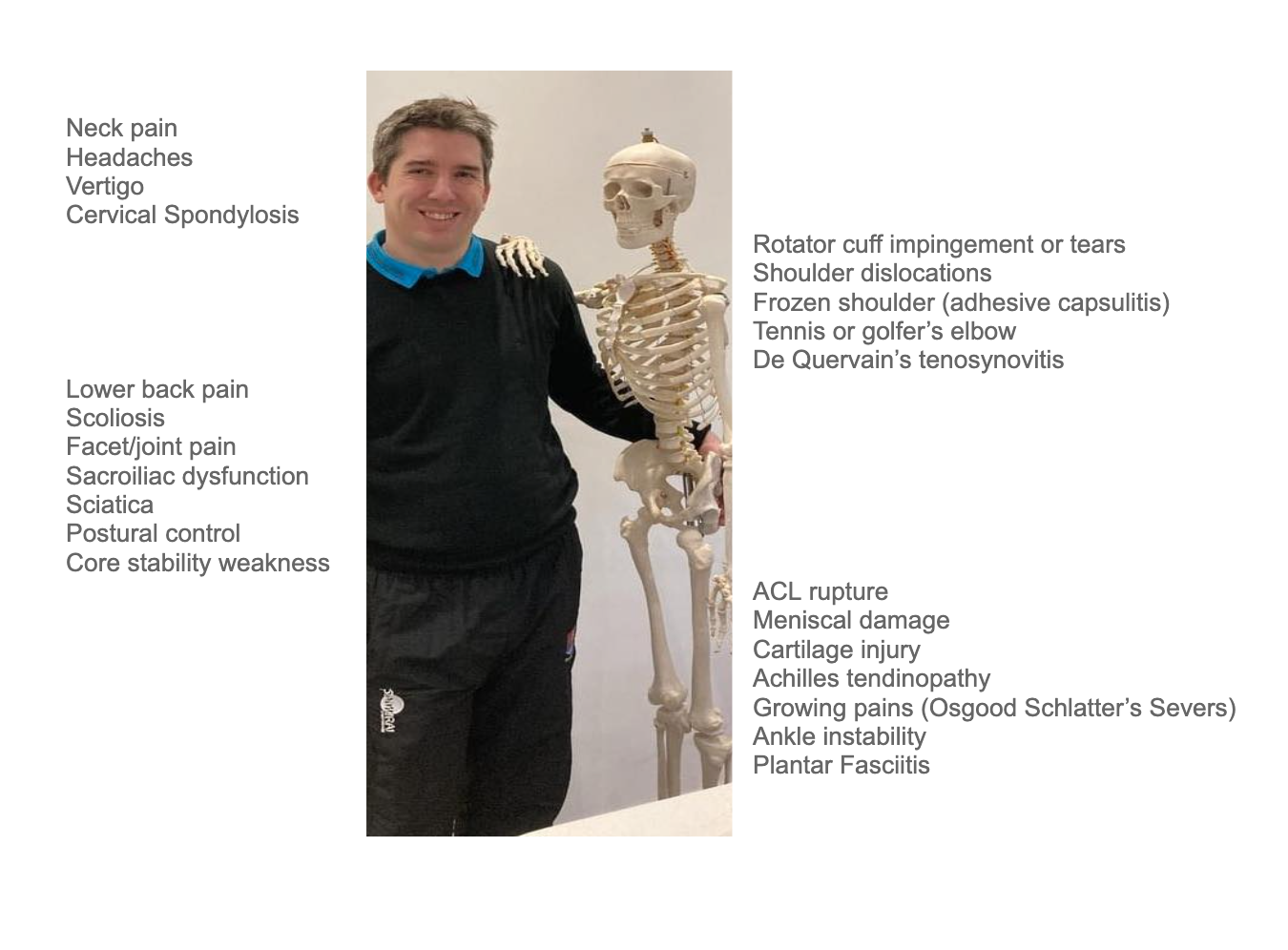
Conditions We Treat
Examples of conditions treated
Not all but most injuries require treatment that incorporate professional advice, massage, mobilisations, manipulation, acupuncture or exercise. Length of treatment depends on nature and severity of injury.
This is not an exhaustive list, but examples of conditions treated with physiotherapy include tendinopathies, facet joint dysfunction, disc bulges, osteoarthritis or joint degeneration, muscle strains or tears, ligament sprains or tears, surgeries or joint replacements, dislocations, nerve injuries, bursitis, fractures, rotator cuff impingement, muscle spasms, and lymphoedema.
Specific examples by area include:
Head / Neck: headaches, vertigo, stiffness, disc injuries, facet joint irritation
Shoulder: rotator cuff impingement, tendinopathies, tendon tears, dislocations, frozen shoulder
Arm/Elbow/Wrist: tennis or golfer’s elbow, De Quervain’s, trigger finger, wrist fractures
Spine/Back: arthritis, disc injuries, facet joint irritation, muscle spasms, core instability, sciatica
Hip: hip replacements, iliotibial band syndrome, gluteal weakness, greater trochanteric pain syndrome
Knee: meniscal tears, cartilage damage, anterior knee pain, ligament sprains and muscle strains
Ankle/Foot: Achilles tendinopathy, shin splints, ligament sprains, plantar fasciopathy / fasciitis
Physiotherapy helps manage these conditions by reducing pain, improving movement, restoring strength, and supporting a safe return to daily activities, work, and sport. Please see below for further reference.
Common conditions
Tendiopathy
Tendinopathy is a common cause of pain in a tendon. It used to be called “tendinitis” because it was thought to be caused by inflammation. We now know that tendon pain is more often due to wear, overload, or changes in the tendon over time rather than inflammation alone. Tendinopathy commonly affects areas such as the rotator cuff (shoulder), Achilles tendon (ankle), gluteal tendons (hip), and the outside of the elbow (often called tennis elbow). Physiotherapy is an important part of recovery, with specific exercise programmes helping to strengthen the tendon and reduce pain. Eccentric exercise has been found to be the best type of exercise for tendinopathies. These exercises are carefully progressed to help the tendon heal and return to normal function.
Facet joint dysfunction
Facet joint irritation is a common cause of neck and lower back pain. Facet joints are the small joints in the spine that connect the bones (vertebrae) together. These joints can become irritated due to age-related changes, inflammation, or injury. Pain from facet joints can sometimes be felt in other areas, such as the shoulder blade, hip, or thigh. Symptoms are often worse with movements that involve bending backwards, twisting, or compressing the spine. Physiotherapy can help reduce pain and improve movement through a combination of targeted exercises and hands-on treatment, supporting a safe return to everyday activities and sport or physical activity.
Disc bulge
Disc bulges are a common cause of spinal pain, especially in the lower back. Your spinal discs sit between the bones of your spine and act like cushions, helping your spine move and absorb pressure. You can think of them like a car tyre filled with chewing gum — tough on the outside, softer in the middle. Sometimes a disc can bulge / herniate, which is often called a “slipped disc.” This can cause back pain, and if it presses on a nerve “trapped nerve”, it can lead to symptoms like pain, tingling, or numbness down your arm or leg. Pain in the leg from a disc bulge is often called sciatica. Disc bulges can happen because of normal changes with age or after an injury. Physiotherapy can help by giving advice, hands-on treatment, and exercises tailored to your needs. This approach can reduce pain, improve movement, and help you get back to your daily activities.
Osteoarthritis / degeneration
Osteoarthritis is a common condition that often affects the knees, hips, spine and hand joints. In osteoarthritis, the smooth cartilage that covers the ends of the bones can become rough, and small bony growths called osteophytes may form. This can lead to joint pain, swelling, and reduced movement. Physiotherapy can help improve movement and function. Treatment may include advice and education, hands-on therapy, and exercises. Strengthening the muscles around the joint can help reduce pain, support the joint, and make everyday activities easier.
Muscle strain / tears
Muscle strains and tears occur when a muscle is overstretched or overloaded, commonly during heavy lifting or sports. They often affect areas such as the hamstrings, groin, lower back, and calf. These injuries are graded on a scale from 1 to 3 based on severity, with symptoms including pain, swelling, and sometimes bruising. Physiotherapy can help manage the acute injury, restore range of motion, reduce pain, and provide hands-on treatments like soft tissue massage, as well as strengthening exercises to lower the risk of re-injury.
Ligament sprain / tears
Ligaments are soft tissues that connect bone to bone and help keep joints stable. Common ligament injuries occur in the knee, such as the ACL, and in the lateral ankle. These injuries are often caused by sudden deceleration, twisting, pivoting, joint overload, or trauma. Typical symptoms include joint instability, pain, swelling, bruising, and reduced range of motion. Ligament injuries are graded on a scale from 1 to 3 based on severity. Physiotherapy can help manage the acute injury, restore movement, reduce pain and swelling, and support a safe return to normal activities or sport.
Meniscal injuries
The meniscus is a soft tissue structure in the knee that acts as a shock absorber to protect the joint cartilage. Meniscal injuries commonly occur during twisting or compressive movements, especially when the knee is bent, and may be associated with ligament injuries. In some cases, a “bucket handle tear” can occur, where part of the meniscus becomes trapped and causes knee locking or difficulty fully straightening the leg. Symptoms often include pain along the middle, side, or back of the knee, along with swelling and reduced range of motion. Physiotherapy helps reduce pain and swelling, restore movement, and strengthen surrounding muscles to assist with recovery.
Surgeries / joint replacements
Surgeries are performed to relieve pain, restore movement, and improve function when conservative treatments are not enough. Common procedures include joint replacements (knee, hip, shoulder), ligament reconstructions (e.g., ACL), meniscal or tendon repairs (e.g., rotator cuff), and ORIF (metal plates or screws). Physiotherapy before surgery helps optimise strength and mobility, reduce pain and swelling, and prepare the body for the procedure. After surgery, rehabilitation focuses on restoring range of motion, rebuilding strength and balance, and supporting a safe return to daily activities, with programs tailored to each patient’s needs.
Dislocations
Joint dislocations occur when a joint is forced beyond its normal range of motion, often pushing the bone out of its socket and sometimes requiring relocation in an emergency setting. Commonly affected joints include the shoulder, elbow, and patella (kneecap). Joint instability can persist after a dislocation, increasing the risk of re-injury, with factors like hypermobility further raising this risk. Physiotherapy is important for assessing the joint, identifying any additional injuries, and providing targeted strengthening and stability exercises to prevent ongoing instability and future dislocations.
Nerve damage or injury
Nerve injuries can occur when a nerve is compressed, stretched, or severed, often due to trauma, surgery, repetitive strain, or underlying medical conditions. Proper screening is important to identify any underlying causes. Symptoms may include abnormal sensations, pain, weakness, muscle wasting, and loss of function. Once assessed, physiotherapy can help restore optimal function through pain management, hands-on treatment, stretching and strengthening exercises, and functional rehabilitation.
Bursitis
Bursitis is a common condition that occurs when a bursa becomes inflamed. Bursae are small, fluid-filled sacs that cushion and reduce friction between muscles, bones, and tendons. Bursitis often develops due to repetitive movements, injury, prolonged pressure, or age-related / degenerative changes. Symptoms can include swelling, inflammation, pain, and reduced movement or function in the affected area. It may also occur alongside tendinopathies or other tendon-related issues. The joints most commonly affected are the elbow, knee, shoulder, and hip. Physiotherapy plays an important role in managing bursitis by providing advice on reducing inflammation, modifying activities to minimise overload or pressure, and prescribing exercises to improve flexibility and strengthen the muscles and tendons surrounding the joint.
Fracture / broken bone
A fracture occurs when a bone in the body breaks. There are many types of fractures, and more severe injuries may require surgery to allow proper healing. Fractures are commonly caused by trauma such as falls, road traffic accidents, or sports injuries, while stress fractures can develop over time due to repeated mechanical overload. Symptoms often include pain, swelling, bruising, and reduced function. After a period of immobilisation in a cast or brace, joints may become stiff and muscles weak. Treatment depends on the type and location of the fracture and the stage of healing. Physiotherapy plays an important role both conservatively and after surgery by supporting optimal healing, reducing pain and inflammation, restoring joint movement and muscle strength, and managing scar tissue. With guided physiotherapy, most people can safely return to daily activities, work, and sport while minimising the risk of long-term stiffness or re-injury.
Rotator cuff impingement
Rotator cuff impingement is a common shoulder problem that happens when the tendons in the shoulder become irritated or squeezed in a small space at the top of the joint. This can develop over time due to ageing, repetitive overhead activities, poor posture, or shoulder overuse. It often causes pain in the shoulder or upper arm, especially when lifting the arm above shoulder height, reaching, or lying on the affected side. Physiotherapy can help by reducing pain, improving shoulder movement, and strengthening the shoulder muscles. Treatment also focuses on improving posture and movement to help you return safely to everyday activities, work, and sport.
Muscle spasm
Muscle spasms are painful, involuntary muscle contractions that cause tightness, reduced movement, and difficulty with normal function. They commonly occur in areas such as the neck and lower back and can be caused by heavy lifting, poor posture, muscle overload, trauma, or sports injuries. Physiotherapy aims to reduce the initial muscle spasm and relieve pain through hands-on treatment such as soft tissue massage, alongside exercises that help to restore movement, strength, and normal function, and reduce the risk of the problem returning.
Lymphoedema
Lymphoedema is a long-term condition where the lymphatic system does not work effectively, leading to swelling in the arms or legs. It commonly develops after cancer treatment, surgery, injury, or infection, and can cause symptoms such as heaviness in the limbs, pain or discomfort, tightness, and reduced movement. Physiotherapy can help by providing support, manual lymphatic drainage techniques such as massage, and advice on management strategies including compression and skin care. Specialised exercises may also be provided to help reduce symptoms and enable people to maintain their independence and continue with daily activities and hobbies.
Sports massage uses various techniques to help with muscle pain, reduce muscle tension, improve flexibility and help prevent injuries. Muscle issues can limit flexibility, increase pain and increase risk of future injury. Sports massage is beneficial to the over and under active of us.